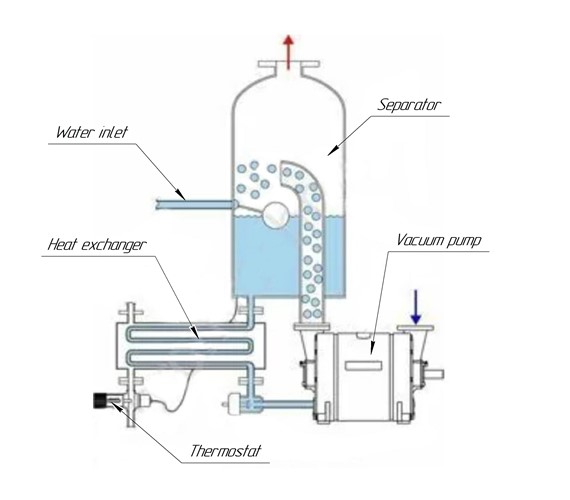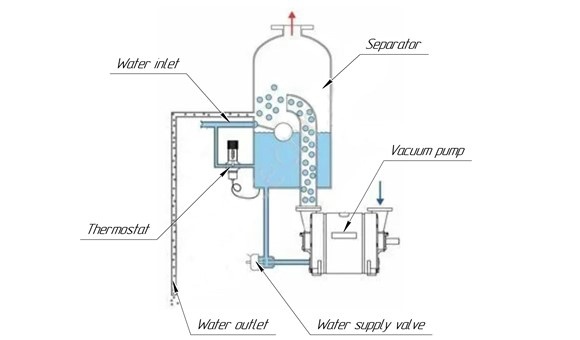
A liquid ring vacuum pump is a pump that requires water to operate. This is determined by its operating principle: water forms a liquid ring inside the working chamber, which in turn creates a vacuum of a specific level.
There are several basic schemes for supplying the working liquid:
Once-through (flow-through) water supply method
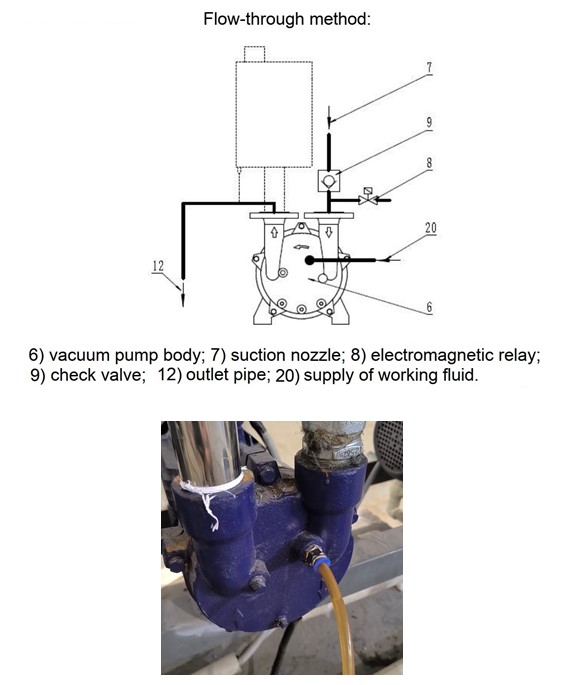
The water leaving the pump can be discharged directly into the sewer system, which is the simplest solution. Sometimes this method is used, for example, when the evacuated air contains soot particles that settle in the water. Since the liquid becomes contaminated, it is disposed of permanently, as reusing such water would quickly reduce the service life of the pump itself.
However, because this method is very uneconomical, systems with a separator and partial recirculation are most commonly used.
Separator with partial recirculation
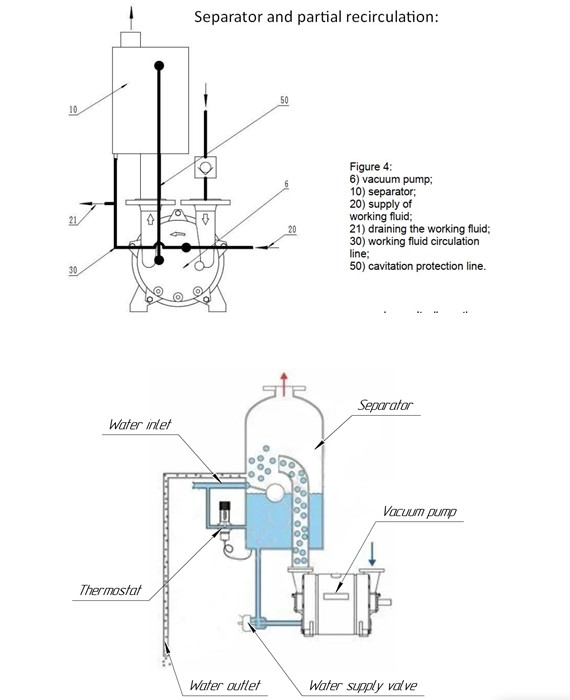
This supply method helps to save part of the water. A portion of the working liquid settles in the separator and flows directly back to the pump without any cooling. At the same time, part of the liquid is lost due to evaporation and is replenished with fresh water.
The most efficient solution is a recirculation system using a water-cooled heat exchanger. In the diagram below, a heat exchanger and a second external water circuit are added. On its return path to the pump, the liquid from the separator passes through the heat exchanger, where it transfers heat to the water in the additional circuit. A thermostatic control valve regulates the water supply to the external circuit.
Separator with full recirculation and heat exchanger